September Highlights: C4IP Launches New Website to Correct Patent Misinformation
For years, the Initiative for Medicines, Access & Knowledge — better known as I-MAK — has sought to undermine America’s intellectual property system by advancing false narratives about drug patents. I-MAK purports to explain these myths, such as “patent thickets” and “product hopping,” using data. However, other research — including from the U.S. Patent and Trademark Office — has exposed flaws and oversights in I-MAK’s data, such as exaggerated patent counts. C4IP has consistently urged policymakers and the public not to take I-MAK’s assertions at face value, as narratives that are not grounded in evidence could mislead policymakers into making decisions that undermine IP rights and innovation.
In September, C4IP launched www.I-MAKexposed.com, a new website designed to help policymakers, journalists, and the public understand where I-MAK presents unreliable data. The site details why, contrary to many of I-MAK’s claims, strong patent protections in the life science industry are vital to ensure the development of new, lifesaving treatments and cures.
- C4IP Executive Director Frank Cullen issued a statement announcing the launch of I-MAK Exposed and explaining the website’s mission of correcting patent misinformation.
- C4IP’s launch of I-MAK Exposed was featured in IPWatchdog’s weekly “Barks & Bites” news roundup for the week of September 19.
- I-MAK Exposed was cited in an IPWatchdog article on the problem of patent misinformation, which focused on false claims about biologic patents made in Nature Biotechnology and Amgen’s subsequent response correcting them.
Additional Coalition Updates
- On October 7, C4IP Executive Director Frank Cullen submitted a letter to the Senate Judiciary IP Subcommittee ahead of its hearing, “The Patent Eligibility Restoration Act — Restoring Clarity, Certainty, and Predictability to the U.S. Patent System.” The letter expressed strong support for the legislation, emphasizing that PERA would restore U.S. patent eligibility for critical technologies like medical diagnostics, life sciences, and computer-related inventions, and reaffirm America’s global leadership in innovation.
- C4IP’s letter was featured in IPWatchdog’s coverage of the hearing.
- On October 7, C4IP Chief Policy Officer and Counsel Jamie Simpson was featured in an MLex article discussing the October 8 PERA hearing and the broader debate over Section 101 patent eligibility reform. Simpson noted that the uncertainty caused by recent Supreme Court decisions has forced innovators to “turn away from research projects” in affected fields and that PERA would provide a more predictable framework for determining what is eligible for patent protection.
- On September 18, C4IP Executive Director Frank Cullen submitted a letter to the House Judiciary IP Subcommittee ahead of its hearing “AI at a Crossroads,” cautioning that a federal moratorium on state AI regulation would foreclose opportunities for states to protect creators’ intellectual property rights from potential AI abuses.
- On September 18, C4IP issued a statement congratulating John Squires on his confirmation as the new Under Secretary of Commerce for Intellectual Property and Director of the U.S. Patent and Trademark Office and urging him to continue supporting pro-IP policies as he has throughout his career.
- On September 16, C4IP Board Member Judge Kathleen O’Malley (ret.) and Chief Policy Officer and Counsel Jamie Simpson spoke at IPWatchdog’s second annual Women’s IP Forum in Ashburn, Virginia with O’Malley leading a keynote fireside chat and Simpson featured on a panel on recent IP policy developments in Washington.
- On September 15, C4IP Chief Policy Officer and Counsel Jamie Simpson spoke on a panel discussion about the legal and strategic challenges of licensing and commercializing trade secrets at the Trade Secret Legal Protection 2025 conference in Boston.
- On September 8, C4IP Co-Chair Andrei Iancu was quoted in an Axios article on China’s surging biotech industry, warning about China’s growing dominance in AI, chemistry, and other sectors.
Government Rundown
Senate Judiciary Committee, Subcommittee on Intellectual Property Hearing: The Patent Eligibility Restoration Act — Restoring Clarity, Certainty, and Predictability to the U.S. Patent System:
On October 8, the Senate Judiciary Subcommittee on Intellectual Property held a hearing on the Patent Eligibility Restoration Act (PERA) to examine how the bill would clarify patent eligibility under Section 101 and its implications for U.S. innovation and competitiveness. C4IP Co-Chairs Andrei Iancu and David Kappos were among the witnesses. C4IP also submitted a letter ahead of the hearing, in support of the legislation, underscoring that a predictable patent system is vital to the United States’s innovative strength. (Senate Judiciary Committee, 10/8)
USPTO Event: Trade Secrets and AI:
On September 23, the USPTO held a symposium in Alexandria, Virginia, to discuss the state of trade secret law and the role trade secrets play in artificial intelligence development. The program included presentations and panel discussions, which featured a variety of USPTO officials, practicing IP attorneys, law professors, and policy executives as speakers. (USPTO, 9/23)
House Judiciary Committee, Subcommittee on Courts, Intellectual Property, Artificial Intelligence, and the Internet Hearing: AI at a Crossroads: A Nationwide Strategy or Californication?:
On September 18, the House Judiciary Subcommittee on Courts, Intellectual Property, Artificial Intelligence, and the Internet held a hearing to discuss whether a federal moratorium on state-level AI regulation is necessary to ensure clarity and predictability for the AI industry. C4IP submitted a letter ahead of the hearing, cautioning that, in fact, a moratorium would cause harm by limiting state policymakers’ ability to protect against AI threats to creators’ and inventors’ IP. (House Judiciary Committee, 9/18)
Confirmation of John Squires as U.S. Patent and Trademark Office Director:
On September 18, the U.S. Senate voted 51-47 to confirm John Squires, an experienced IP attorney, as Under Secretary of Commerce for Intellectual Property and Director of the U.S. Patent and Trademark Office. C4IP issued a statement congratulating Squires and underscoring how he can promote American innovation by upholding IP protections, reducing patent and trademark application backlogs, and supporting technology commercialization. (Commerce Department, 9/18)
USPTO Event: Invention-Con 2025: Empowering American Ingenuity and Innovation:
On September 9-10, the USPTO held its flagship virtual conference for independent inventors and entrepreneurs. Panel discussions and fireside chats across the two-day span featured a variety of experts from within the USPTO, inventors, and small business owners and executives. (USPTO, 9/9-9/10)
Fact Check
The word “open” has become increasingly misused in the world of technology standards. In policy and antitrust terms, an open standard is one developed through an open and transparent process, including through the use of voluntary fair, reasonable, and non-discriminatory (F/RAND) licensing commitments — allowing any company to participate in standards development and any implementer to use essential technologies on transparent, balanced terms. That framework ensures that collaboration fosters competition, not control, keeping markets dynamic and innovation flowing.
Some developers of proprietary standards may offer a standard that is marketed as “open” and “royalty free” but without any F/RAND commitments. This regrettably conflates “open” with “royalty-free.” Proprietary standards developed without F/RAND commitments raise many potential problems — and are not necessarily “open.”
As Deputy Assistant Attorney General (DAAG) Dina Kallay underscored in a recent keynote speech, “collaborative standards development assured by contractual F/RAND commitments has been enormously successful, generating great benefits for consumers.” On the other hand, the Department of Justice (DOJ) is “concerned about … a breakdown of the FRAND-assured standard development ecosystem.”
DAAG Kallay cites abuse of proprietary standards — that do not use F/RAND — as one such breakdown. As DAAG Kallay explained, if such a standard is developed by dominant market players, the requirement of “mandatory, royalty-free cross-licensing . . . allows a group of dominant implementers to fix the price of royalties at zero,” even if that is not what other innovators want. This approach effectively hijacks the standard-setting process to exclude innovators who rely on licensing their intellectual property. Such a standard is not truly “open” — it is effectively closed to entities who rely on licensing their technology to fund future research and development.
As DAAG Kallay stated, “[i]f adequate royalties reflecting the value of a technology cannot be earned, the incentives for companies to invest in R&D are diminished.” Consequently, “over time, successful proprietary standards may push out other truly open standards that would better support interoperability and innovation. Collaborative, F/RAND-assured processes promote openness and inclusion, while mandatory “royalty-free” schemes among dominant implementers can create closed systems that distort competition and weaken incentives to innovate.
These risks have been recognized for a long time. The DOJ and Federal Trade Commission’s (FTC) Antitrust Guidelines for the Licensing of Intellectual Property — first issued in 1995 — note that cross-licensing arrangements may harm competition when participation is limited or when members are required to license their technologies at minimal cost, reducing incentives for research and development.
The Alliance for Open Media (AOMedia) — a consortium led by Big Tech firms including Google, Amazon, and Microsoft — provides a recent example. Just a few days before DAAG Kallay’s keynote speech, it announced the upcoming launch of a new video-compression technology standard called AV2, which it billed as “royalty-free” and “open.”
It remains to be seen whether the “royalty free” claim will prove accurate, or whether outside firms own patents that will cover the standard — as happened with the previous version — potentially leaving implementers exposed to outside licensing costs, further calling into question this standard’s claims of being royalty-free and open. In any case, by attempting to eliminate royalties for the use of a new technology altogether, this approach can distort the market, discouraging innovation and disadvantaging smaller firms.
Below, we set the record straight:
| Claim: A “royalty-free” standard means companies can implement it at no cost. |
| In reality: That’s rarely the case, for several reasons. First, even if the patent owners do not charge a royalty, they may demand valuable non-monetary consideration. AOMedia, for example, requires users of the standard to agree to license back any applicable patents at a zero royalty. While this may not be a problem for users who do not own relevant intellectual property, it imposes a high cost on users who own valuable patents. This will be a strong disincentive for such a user to develop future iterations of that technology. Second, as the prior AOMedia standard demonstrates, the royalty-free commitment only applies to patent owners who participated in the development of that standard. Innovators who could not agree to the royalty-free commitment — and therefore did not participate in the development of that standard — have not made any commitments.
As DAAG Kallay explained in her keynote speech, those external rights create uncertainty for implementers who assume the technology is fully royalty-free. She further related that such “essential patent holders would be able to legitimately charge implementers whatever terms of conditions they deem fit or, worse yet, legitimately exclude implementers . . . from the marketplace through injunctions.” DAAG Kallay noted that this can lead to wasted development work and even deter companies from adopting the standard in the first place. The risk isn’t hypothetical: the previous version of AV2 left prospective implementers uncertain about potential infringement exposure and whether they could adopt the technology without securing additional licenses. |
| Claim: Mandatory “royalty-free” licensing promotes an open, competitive industry. |
| In reality: Not necessarily. When “royalty free” commitments are mandatory and not voluntary, neither the standards development process nor the use of the standard is truly open. Such commitments can effectively force developers and users to surrender returns on their own innovations. That structure can discourage participation by smaller innovators that rely on licensing revenue while reinforcing the position of large implementers with diversified income streams.
As DAAG Kallay warned in her keynote speech, mandatory royalty-free cross-licensing among dominant implementers “allows a group … to fix the price of royalties at zero” — a dynamic that can operate as a collusive scheme promoting closed, proprietary standards. These dominant implementers frequently have other means to earn revenue from the widespread adoption of their standard, such as through sales of hardware or advertising. The DOJ–FTC Guidelines similarly caution that cross-licensing among firms with collective market power can harm competition when participation is limited or when members are required to license their technologies at minimal cost. AOMedia’s “royalty-free” model reflects this broader pattern. Its licensing agreement requires members to grant reciprocal, royalty-free licenses for patents essential to AV1 and AV2 — waiving the right to enforce those patents against other members. For smaller innovators that rely on licensing revenue, that tradeoff makes participation economically unrealistic. The result is a structure that reinforces the dominance of major implementers while effectively locking smaller firms out of contributing to or using an allegedly “open” standard. |
| Claim: Eliminating royalties fosters innovation. |
| In reality: Patent royalties are what sustain long-term innovation by allowing inventors to recover R&D costs and reinvest in new technologies. When standards bodies eliminate royalties or require contributors to share improvements for free, they remove that incentive and risk slowing progress.
As DAAG Kallay emphasized in her keynote speech, if adequate royalties reflecting the value of a technology cannot be earned, the incentives to invest in R&D are diminished and market innovation suffers. The DOJ–FTC Guidelines describe a similar risk in their discussion of grantback provisions — arrangements requiring licensees to give improvements back to licensors — which can substantially reduce licensees’ incentives to engage in R&D and limit rivalry. AOMedia’s “royalty-free” approach to AV2 demonstrates the risk. By eliminating royalties and requiring members to cross-license their patents, the model benefits large firms that can absorb the loss of licensing revenue while disadvantaging smaller innovators that depend on it. Companies that join forfeit the ability to profit from their own breakthroughs, discouraging smaller firms from investing in new technologies and further consolidating market power among the Big Tech members that lead the consortium. |
Celebrating American Innovation
Inventor Spotlight
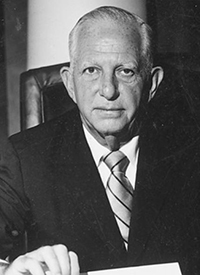
This month, C4IP is honoring Malcom McLean (1913-2001), whose invention of containerized shipping revolutionized global trade.
- Born into a farming family in North Carolina, McLean started a successful trucking company during the Great Depression, but he became frustrated by the time he spent waiting for crates to be transferred between trucks and ships.
- Believing there was a more efficient way to transport cargo on ships, McLean invented a system of sturdy steel containers that could be stacked and easily separated from truck trailers, which he patented in 1958.
- McLean founded a company called Sea-Land to commercialize his invention, which quickly became an industry leader worth $160 million ($1.4 billion in 2025 dollars).
- McLean’s invention had an immense economic impact, cutting port handling costs by more than 90% — from nearly $6 per ton to about $0.16 per ton — and making shipping operations dramatically faster.
- Today, container ships move approximately 90% of global trade.
- In total, container ships transport over $7 trillion worth of goods each year, according to the World Shipping Council.
- By making long-distance trade cheap and reliable, McLean’s innovation helped create modern supply chains, fueled global interconnectedness, increased consumer access to goods, and allowed U.S. businesses to more easily export their products around the world.
(PHOTO: National Inventors Hall of Fame)
What’s Happening in Congress
With the 119th Congress underway, Democratic and Republican lawmakers are weighing legislation to prioritize strengthening IP protections, including the recent reintroduction of several significant bills from the previous Congress:
- The Patent Eligibility Restoration Act (PERA), which would revitalize innovation and investment in crucial high-tech sectors by reversing arbitrary, judicially created exceptions to patent eligibility.
- The Promoting and Respecting Economically Vital American Innovation Leadership (PREVAIL) Act, which would level the legal playing field for inventors and give them a fair chance to defend their patents from unauthorized infringement by larger competitors.
- The Realizing Engineering, Science, and Technology Opportunities by Restoring Exclusive (RESTORE) Patent Rights Act, which was reintroduced in both the House and Senate. This bipartisan, bicameral legislation would reestablish injunctive relief as the primary legal remedy for patent infringement, reaffirming innovators’ constitutional rights to the exclusive ownership of their inventions.
- The Nurture Originals, Foster Art, and Keep Entertainment Safe (NO FAKES) Act, which would protect all individuals from having their voice and visual likeness copied by generative AI without consent.
We will continue to track movement on these bills and provide updates on legislative developments in upcoming editions. In the interim, you can find resources on these key issues here.